
If your home just had a water, fire, mold, or storm loss, your insurance company will assign a field adjuster who will visit, write up a scope of work, and tell you that scope is what they will pay. That initial scope is almost always low. Not because the adjuster is dishonest: most aren't, but because the way insurance adjusting works structurally produces low scopes. I want to explain why, what gets missed, and what to do about it.
Why initial adjuster scopes run light
Insurance field adjusters typically visit your property once. For 30-60 minutes. They walk through, take photos, write notes, and produce a scope using Xactimate (the industry-standard scoping software). It is a fast, visual process.
Three structural problems with that:
- They can't see inside walls. Water wicks up studs invisibly. Smoke residue saturates wall cavities. Mold grows behind drywall. An adjuster looking at a wall in good light cannot detect any of it.
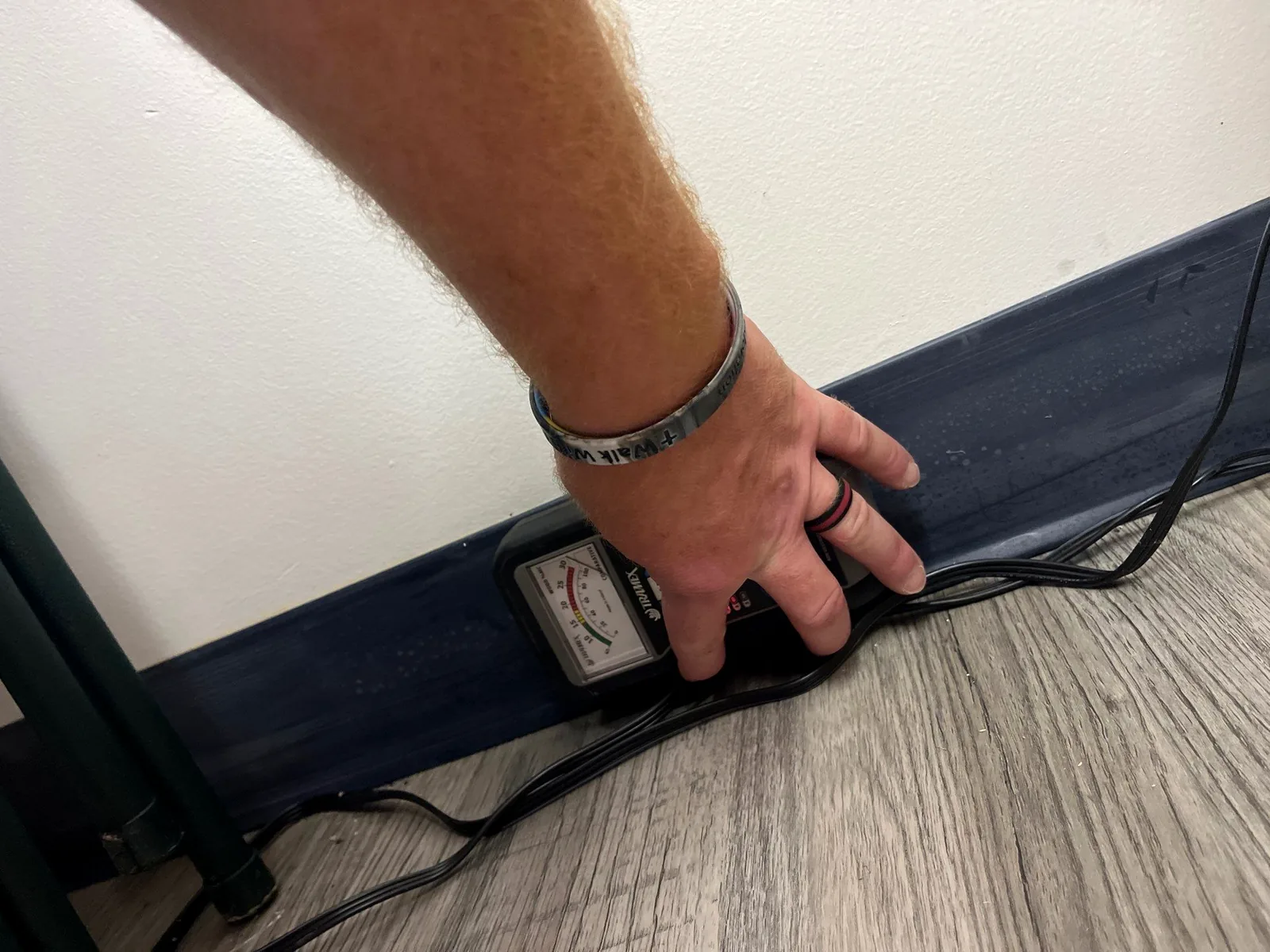
- They don't have time to test moisture content. Wet framing reads normal to the eye for days after a water loss. Without a moisture meter, the adjuster has no way to know how far the damage has wicked.
- They're solving for claims volume, not your specific outcome. Field adjusters carry caseloads of 30-100+ open claims. The incentive is to write a defensible scope quickly and move on. Generous scoping that takes 90 minutes per visit doesn't fit the workload.
What typically gets missed
- Hidden moisture in framing and subfloor. Visible drywall damage gets scoped. The 4 feet of wet framing behind it does not.
- Soft-goods cleaning. Clothing, linens, curtains, area rugs: these get listed as "homeowner to handle" when the policy actually covers professional cleaning.
- Ductwork cleaning after fire smoke. Smoke residue travels through the HVAC into every room. Without proper duct cleaning, odor and contamination remain.
- Antimicrobial treatment after Cat 2 or Cat 3 water. Required by IICRC standard but routinely omitted from initial scopes.
- Equipment runtime. Adjusters estimate 3 days of drying when an actual moisture content read says 5-6 days.
- Like-kind-quality replacement. Your hand-scraped hardwood gets scoped as builder-grade engineered floor.
- Mold remediation after water loss. Water sat 48+ hours, mold is starting: adjuster skips the remediation line item.
- Reasonable matching. Damaged-side trim replacement scoped without matching the rest of the room.
A real example (anonymized)
A finished basement in Carmel had a sump pump failure. 600 gallons of water across a 1,100 sq ft finished space. The adjuster's initial scope: $14,200. We documented the full scope including hidden wall wicking (verified via thermal imaging + moisture meter readings on framing), soft-goods cleaning, antimicrobial treatment, and equipment runtime to actual moisture targets. Our scope: $26,800. The carrier paid $24,600 after negotiation. Homeowner pocketed $10,400 they would not have seen otherwise.
How to push back
- Get a restoration company on-site before the adjuster. A reputable restoration company writes an independent Xactimate scope on day one: the same format the adjuster uses. When the adjuster's scope arrives, you have something to compare against.
- Insist on the restoration company's presence at the adjuster's walk-through. Adjusters write very different scopes when a contractor is standing next to them pointing out hidden damage.
- Document everything. Photos, moisture readings, thermal images. Build a case file.
- Submit your supplemental scope in writing. Don't argue verbally: submit a line-by-line comparison.
- Know what is reasonable to push on. Some line items are non-negotiable industry standards (e.g. antimicrobial treatment after Cat 2 water: IICRC standard). Some are judgment calls (e.g. like-kind quality replacement: depends on policy language).
What we do at Guardian Angel
On every job we run, we:
- Write our own Xactimate scope on day one
- Document moisture readings, thermal images, photo inventory
- Attend the adjuster's walk-through with you
- Submit our scope side-by-side with the adjuster's
- Push back line by line on under-scoped items
- Do not roll over on industry-standard items the carrier wants to cut
This is what insurance advocacy actually means. Not "we work with insurance." Not "we accept all insurance." Active advocacy on your behalf, in the technical language of Xactimate, with the documentation to back every claim.
Related reading
- How to read your homeowners insurance policy
- The first 60 minutes after water damage
- Insurance claim help overview
- State Farm claim help
- Allstate claim help
FAQs
Is it ethical to push back on an adjuster's scope?
Yes. Your policy obligates the carrier to pay for the actual covered damage, not the adjuster's quick estimate of it. Documentation-based supplements are a normal part of the claims process.
Will my carrier drop me if I dispute a scope?
No. Insurance carriers cannot drop you for legitimately documented supplements. They CAN drop you for excessive or repeated unrelated claims, but a single properly-documented supplement on an active loss does not trigger that.
How much does Guardian Angel charge for advocacy?
Nothing extra. Our scope documentation and adjuster walk-through attendance are included in every restoration job. We bill insurance direct based on agreed scope.
Michael Talbot is the founder of Guardian Angel Restoration, a veteran-owned IICRC-certified restoration company serving Hamilton County and Greater Indianapolis.