
The single biggest factor that determines what a water damage event will actually cost you is what happens in the first 60 minutes. Not the size of the leak. Not the age of your house. Not even your insurance policy. The first 60 minutes.
I have run hundreds of water damage jobs across Hamilton County and Greater Indianapolis. The pattern is so consistent it is almost mechanical. A water loss caught in the first 60 minutes typically costs 30-50% less to restore than the same loss caught at 6 hours, and 60-80% less than the same loss caught at 24 hours. Why? Because the science of water damage is brutal: every minute that water sits on hardwood, the wood cups further. Every minute on carpet, the pad bonds to the subfloor. Every minute on drywall, the wicking continues up the studs. And at 24 hours, mold spores that exist everywhere in the air begin to colonize damp surfaces: which moves the entire job into a mold-remediation scope on top of the water mitigation.
So here is what to do, in the order to do it, in that first hour. This is the same advice I give every customer who calls me from a basement that just flooded.
1. Shut off the water source: if you can do it safely.
Find the main shutoff valve. In most Hamilton County homes it is in the basement near where the water line enters the house, or in a utility closet. Turn it clockwise until it stops. If you don't know where it is, this is your assignment for next Sunday afternoon: find it, label it, and make sure everyone in the house knows where it is.
If the water is coming from an appliance: washing machine, dishwasher, refrigerator ice maker, water heater, there is a smaller shutoff valve behind or beside the appliance. Turn that.
If the water is coming from a burst pipe in a wall or ceiling and you cannot find the source, shut off the main and call us. Do not stand in standing water trying to figure out where the leak is.
2. Turn off electricity to the affected area.
Water and electricity together is how people get electrocuted. Before you do anything else in the affected space, go to your breaker box and shut off circuits feeding the rooms where water is present. Bedroom circuits, basement circuits, outlets in the affected zone: all off.
If you have a sump pump and the basement is flooding because the pump failed, leave the sump pump circuit on. The pump still might run intermittently. But everything else: off.
3. Move valuables off the wet floor.
You have minutes before the materials in contact with water start absorbing. Anything you can move: area rugs, electronics, photo albums, important documents, personal items, anything that is irreplaceable, pick it up and put it on a higher surface. A dry table. A counter. An upstairs room.
Do not waste time on furniture you cannot easily lift. Couches and beds can be lifted later, or you can put aluminum foil or wood blocks under the legs to elevate them off the wet floor (this prevents wood-leg staining onto the carpet, which becomes a soft-goods issue later).
Most importantly: photographs, family records, sentimental items. These are what people regret most when they wait too long. We can clean the kitchen. We cannot replace your wedding photo.
4. Document everything before anything is moved.
Take photos. Many photos. With your phone. Standing water, wet drywall, damaged ceiling, every angle. Video walk-throughs are great too. Date and time stamp.
This serves two purposes. First, it gives you and your insurance company a baseline record of what the damage looked like at the start. Second, it makes the eventual insurance claim much more defensible: adjusters tend to under-scope when documentation is thin.
If you have time and water is still actively flowing, also take photos of the source: the burst pipe, the failed water heater, the overflowing washing machine. This proves the cause of loss is a covered peril.
5. Call a restoration company that will be on-site within 2 hours.
This is the most important step, and the one most homeowners get backward. Most people call their insurance company first. Then they wait for the adjuster to call back, then they wait for the adjuster to send a recommendation, then they wait for the adjuster's preferred vendor to show up the next day. By then, your loss has compounded by 30-50%.
Here is the better order: call a reputable local restoration company first, then call your insurance company. A good restoration company will:
- Be on-site within 2 hours (we guarantee this)
- Begin emergency mitigation immediately, no insurance approval required
- Document the loss in Xactimate-grade detail for your insurance file
- Sit with your insurance adjuster during the walk-through
- Push back on under-scoped initial estimates
You are not violating your policy by calling a restoration company before the adjuster. Your policy actually requires you to mitigate damage promptly: that is what we do.
The single thing that goes wrong on most water damage claims
The adjuster's initial scope under-counts the damage. Field adjusters typically visit once for 30-60 minutes and write a scope from what they can visually verify. They cannot see inside walls. They cannot detect moisture in framing. They cannot see how far water has wicked up the studs. The result is an initial scope that often misses 15-30% of the actual covered damage: typically $5K-$30K out of your pocket unless someone documents the rest. Calling a restoration company that documents in Xactimate from day one is the fix.
What NOT to do in that first hour
- Do not start tearing out wet drywall or carpet yourself. If insurance later questions the scope, you have destroyed evidence of the damage. Wait for documentation.
- Do not turn on the HVAC system to "help dry it out." This pushes moisture into ductwork and other rooms, expanding the damage.
- Do not use a household shop vac to "extract" the water yourself. You'll get 5% of it. Truck-mounted units extract 100%. Wait for the pros.
- Do not wait until "regular business hours" to call. Water damage at 2am is the same emergency as water damage at 2pm. We dispatch 24/7.
What we do in our first 60 minutes on your property
Just so you know what to expect: when our crew arrives, here is what happens in our first hour.
- Walk-through with you to confirm the source is shut off and identify all affected areas.
- Moisture mapping with thermal imaging cameras and pin moisture meters. We identify hidden water inside walls and under floors.
- Truck-mounted extraction of all standing water across affected surfaces.
- Removal of unsalvageable wet materials: saturated pad, soaked insulation, anything that cannot be dried in place.
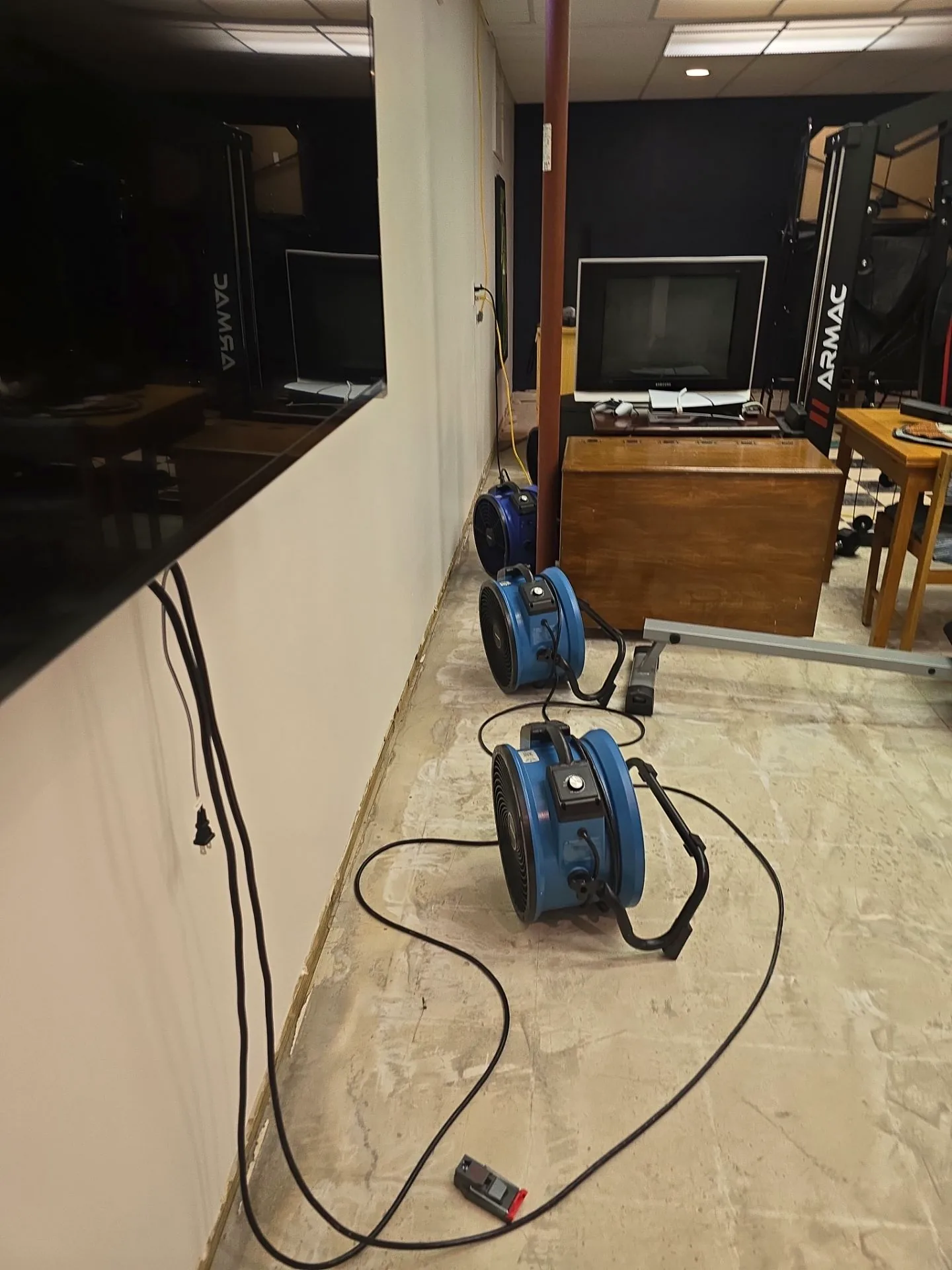
- Initial drying equipment placement: industrial air movers and LGR dehumidifiers begin the structural drying process.
- Documentation: photos, moisture readings, scope notes, all uploaded to your insurance file the same day.
By hour 2, the immediate emergency is contained and the drying clock is running.
Hamilton County specific notes
A few things specific to where we live:
Spring rain events in Noblesville, Carmel, and Fishers drive a huge volume of sump pump failures. If you have a finished basement and your sump pump is over 8 years old, get it inspected before April. Add a battery backup. This is the single best preventive investment you can make.
January and February cold snaps burst pipes in older Indianapolis brick homes (Meridian-Kessler, Irvington, near-southside), in homes with under-insulated rim joists across the metro, and in cabin/lake properties with vacant utility shutoffs. Leave a faucet trickling when temps drop below 10°F.
Geist Reservoir and Morse Reservoir lakefront properties face elevated water-intrusion risk during heavy rain events. If you have a finished walk-out basement on the water, you are at higher risk than the metro average. Check your sump and your dehumidifier seasonally.
What about insurance
Most water damage in Hamilton County is covered by standard HO-3 homeowners insurance. The question is rarely "is it covered": it is "is it covered for the full amount." That is where insurance claim advocacy becomes the most valuable part of what a good restoration company does. Read more about how insurance claims work in restoration →
If you need help right now
Call us. 24 hours a day, 7 days a week. We will be on-site within 2 hours anywhere in Hamilton County and most of Greater Indianapolis.
Phone: (812) 441-4814
We are veteran-owned, IICRC certified, and we begin emergency mitigation the moment we arrive, no insurance claim required.
Related reading
- How to read your homeowners insurance policy
- Hamilton County storm preparedness 2026
- What to do in the first 24 hours after water damage
- Water damage restoration services
- Insurance claim help
FAQs
How fast does water damage spread?
Within the first hour, water soaks into flooring, drywall, insulation, and framing. Within 24 hours, mold spores activate. Within 72 hours, structural materials warp.
Should I call insurance before calling a restoration company?
Call the restoration company first. They mitigate immediately, document properly for insurance, and the insurance claim outcome is usually better.
Will my insurance cover water damage?
Most water damage from sudden plumbing failures is covered under standard HO-3 policies. Sump pump backups and some flood scenarios require separate endorsements.
Michael Talbot is the founder of Guardian Angel Restoration. He is a U.S. military veteran with a career spent in the restoration industry and has personally suffered three catastrophic water losses of his own. Guardian Angel Restoration is veteran-owned, IICRC-certified, and serves Noblesville, Indianapolis, Carmel, Fishers, Westfield, Zionsville, and all of Hamilton County with a guaranteed 2-hour on-site response, 24/7.