Short answer: Within the first 24 hours after a water loss, you'll either protect your home and minimize the claim, or you'll let damage compound and double the cost. The actions below: done in roughly this order, make all the difference.
Minutes 0–5: Stop the water
Identify the source. If it's a supply line break, shut off the main water valve at the house. If it's an appliance leak (dishwasher, washing machine, ice maker), shut off the local valve. If it's a roof leak, you can't stop the source: focus on containing the damage indoors until restoration arrives.
If you can't find the main valve quickly, it's usually located where the water line enters the house (basement, crawl space) or near the water heater. In slab homes, it's often at the front-foundation cleanout or at the meter.
Minutes 5–15: Kill the power
Water and electricity together create both shock and fire hazards. Shut off power to the affected area at the breaker panel. If the panel itself is in the affected zone, do not approach it: call the utility for a service disconnect.
Minutes 15–30: Call for help
Call a local IICRC-certified restoration company. Don't wait until daylight, don't wait until Monday morning, don't try to handle it yourself with shop vacs and box fans. The first hour of a water loss is when mitigation pays the highest dividends: every minute of professional extraction prevents hours of mold remediation later.
If you're in Hamilton County or Greater Indianapolis, that's us: (812) 441-4814, 24/7. We're on-site in 2 hours or less.
Minutes 30–60: Move what you can
While restoration is en route, move salvageable items off wet flooring. Wood furniture on wet carpet will stain and warp within hours. Electronics on the floor are at risk. Lift items onto dry chairs, tables, or higher floors.
Don't try to "extract" water with household vacuums: they aren't rated for water and will destroy themselves. Don't try to dry with hair dryers, fans, or open windows: proper restoration drying uses calibrated commercial equipment that household tools can't match.
Hour 1–2: Document everything
Photograph every affected room from multiple angles. Photograph every damaged item, every piece of damaged building material, every wet square foot of flooring. Take videos walking through. Time-stamp matters: your camera does this automatically.
This documentation drives your insurance claim. Adjusters routinely undervalue scope when documentation is thin. Comprehensive photos and a clear timeline of when the loss started and when mitigation began are some of the strongest evidence you can provide.
Hour 2–4: Restoration arrives. Don't get in the way.
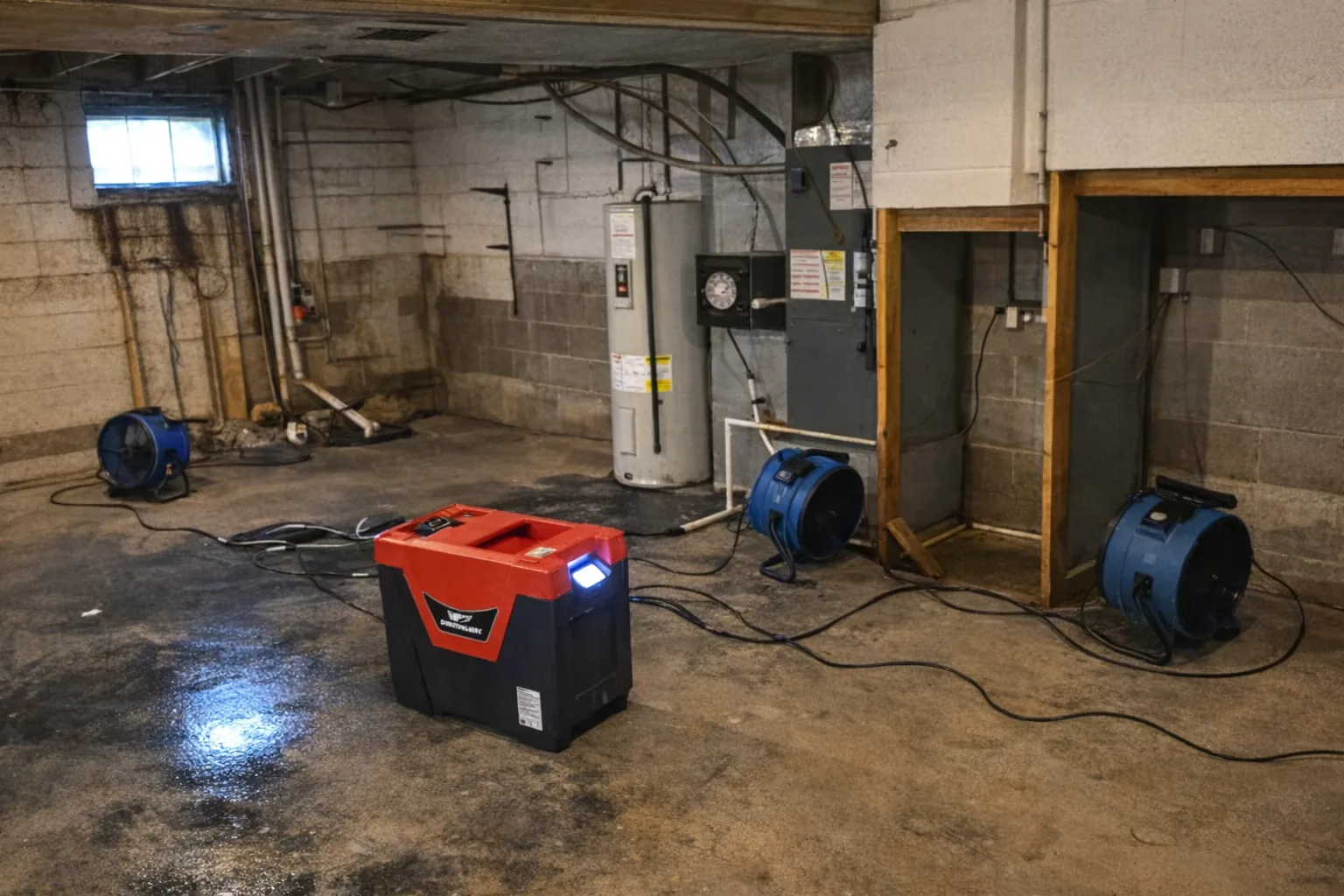
When the restoration crew arrives, they'll do their own moisture mapping using thermal imaging and moisture meters. They'll extract standing water with truck-mounted equipment, remove unsalvageable materials, and deploy commercial drying equipment. This is where speed pays off.
You don't need to do anything during this phase except step back. Take more photos as the restoration crew works: these become part of your claim file too. Make a written note of who you spoke with and when.
Hour 4–8: Call your insurance
Most policies don't require you to call insurance before starting mitigation. Many homeowners assume the opposite: that they have to wait for adjuster approval, and lose hours of critical response time. Read your policy. If you're not sure, call your agent (not the claims hotline) during business hours to confirm.
What insurance does want from you: a prompt notification once mitigation is underway, documentation of the loss, and an estimate from your contractor in scope format the adjuster can review. Your restoration company can handle the latter: we use industry-standard Xactimate scope documentation that adjusters work in daily.
Hour 8–24: Drying is in progress. Stay out of the way.
Commercial air movers and dehumidifiers run continuously through the drying phase. They're loud. They generate heat. They feel disruptive. Don't unplug them or turn them off: they need to run constantly to be effective.
During this window, you should also:
- Begin inventorying damaged contents for your claim. List everything, with original purchase price where possible.
- If you'll be displaced for repairs, ask your insurance about Additional Living Expenses (ALE) coverage: this pays for your hotel, meals, and other costs while your home is uninhabitable.
- Notify your mortgage company if the loss is significant. Many mortgage agreements have a clause requiring notification.
The single biggest mistake homeowners make in the first 24 hours
Waiting for insurance approval before starting mitigation. We see it every week. Homeowner calls insurance Friday afternoon. Insurance says "we'll send an adjuster Monday." Mold begins to grow Friday night. By Monday, the claim is no longer a water claim. It's a water-plus-mold claim, and most policies cap mold at $5,000-$10,000. The homeowner is now out of pocket tens of thousands of dollars they could have prevented.
Read your policy. In nearly every case, you have the right (and the duty) to mitigate damage immediately. Insurance pays for that mitigation. Waiting hurts you, not the carrier.
The 24-hour rule of thumb
If extraction begins within 1 hour of the loss and drying is established within 24 hours, the typical outcome is: full restoration to pre-loss condition, no mold remediation required, insurance pays the full scope, homeowner pays only the deductible.
If those windows slip: extraction starts 24 hours late, drying starts a week late, the typical outcome flips: mold remediation required, partial coverage on the supplemental mold claim, homeowner out of pocket for the difference, restoration timeline doubles.
Speed isn't a marketing line in restoration. It's literally the variable that determines outcome.
Frequently asked questions
What is the very first thing to do when water damage starts?
Shut off the water source. For supply-line breaks, the main water valve. For appliance failures, the local valve. Then shut off electricity to the affected area. Then call restoration.
How long do I have before water damage becomes permanent?
Within hours, flooring and drywall absorb moisture. Within 24 hours, mold activates. Within 72 hours, structural materials warp. The first 24 hours is the critical window.
Should I throw away damaged items before insurance arrives?
No. Document everything first. Insurance claims rely on documentation.
Do I need to file a claim before restoration starts?
No. Mitigation can and should begin immediately. The claim gets filed in parallel.
What if my insurance denies part of the claim?
Push back with documentation. See our insurance claim help guide for specifics.
If you're reading this during a water loss right now
Stop reading. Shut off the water. Shut off the electricity. Call us: (812) 441-4814. We'll be on-site in 2 hours or less, and we'll walk you through the rest.