
Mold spores exist everywhere: in every home, in every breath of air you take. They are not dangerous in their dormant state. What activates them is moisture. Once mold spores find a damp surface, they begin to colonize. In the right conditions, that happens fast. Here is what actually unfolds during the critical 72 hours after a water loss.
Hour 0-24: spore activation begins
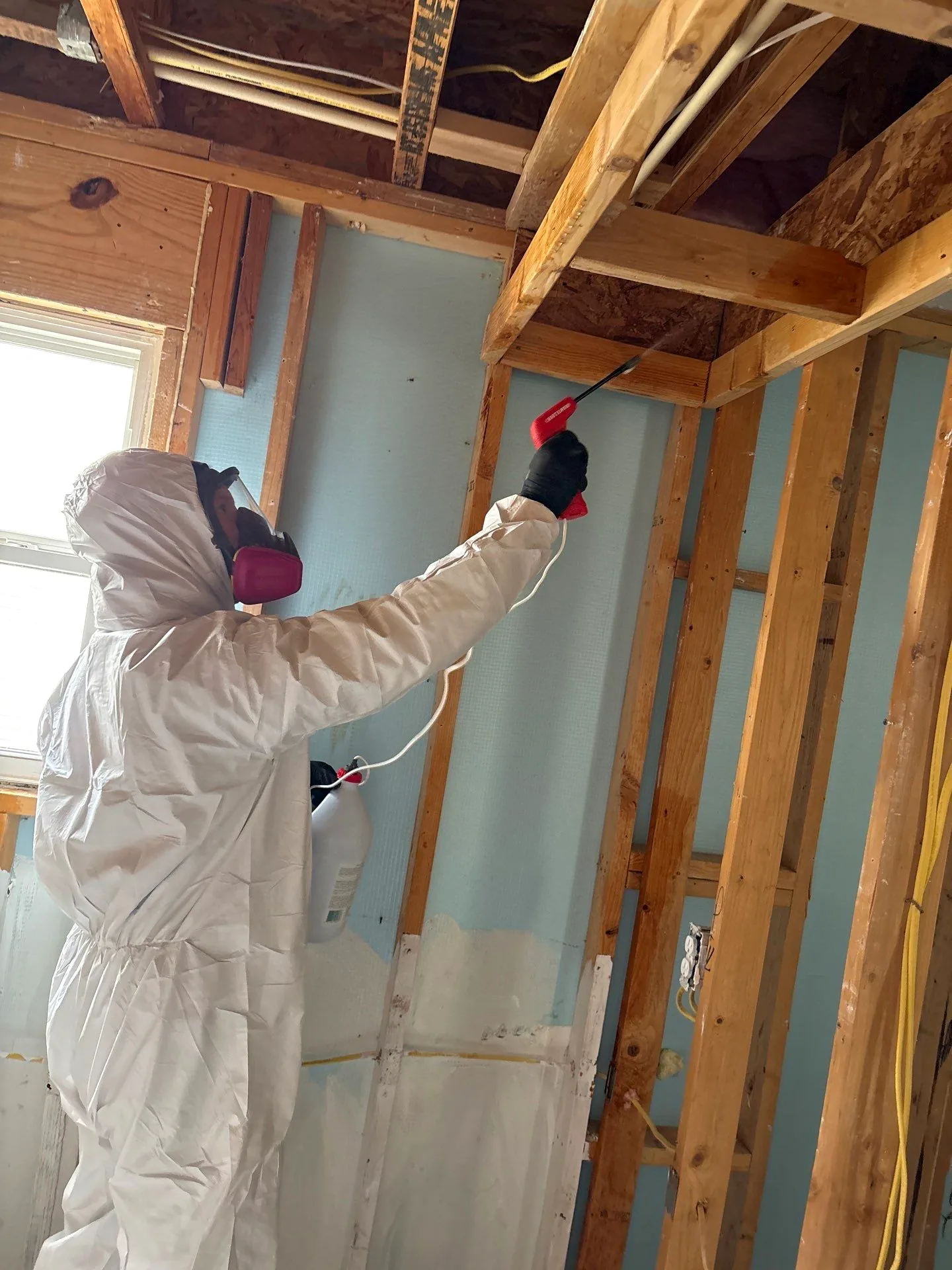
Within the first 24 hours of a water loss, dormant mold spores on damp surfaces begin to germinate. You cannot see this happening. There is no visible growth, no smell. But at the microscopic level, hyphae (the root-like structures of mold) are extending from spore bodies into the substrate.
The materials at greatest risk in this window:
- Drywall (especially paper-faced board, which mold loves)
- Insulation (fiberglass holds moisture and provides organic surface for growth)
- Subfloor materials (OSB, particleboard, plywood)
- Carpet pad (especially when the carpet itself is intact and trapping moisture below)
- Stored cardboard, books, soft goods
If you can get a drying response started in this window, mold growth can be prevented entirely. Materials dry back to normal moisture content (below 16% for most building materials) before colonies establish.
Hour 24-48: visible growth begins
By 24-48 hours, the first visible growth often appears. Small fuzzy patches in dark colors: black, green, gray, or white, on damp surfaces. Most common locations:
- Behind baseboards where moisture has wicked from wet flooring
- On the back of drywall (visible if you cut a probe hole)
- On the bottom of subfloor decking
- On soft goods like carpet pad, padded furniture, stored items
At this stage, a water mitigation job becomes a water mitigation + small-scope mold remediation job. Cost typically rises 20-40%. Insurance carriers may invoke mold coverage caps (typically $5,000-$10,000) at this stage, depending on policy.
Hour 48-72: established colonies + air contamination
By 72 hours, mold colonies are visibly established on multiple surfaces. Spore production has begun. Airborne spore counts in the affected space rise dramatically. The contamination spreads to areas the water never reached: HVAC distribution, adjacent rooms, soft goods throughout the home.
The scope of work now includes:
- Containment (negative-air-pressure chambers to isolate the contaminated area)
- HEPA air scrubbing during cleanup
- Removal and disposal of porous materials (drywall, insulation, soft goods)
- Antimicrobial treatment of remaining surfaces
- Air clearance testing before reconstruction
This is a substantially larger job than the original water mitigation. Costs can run 100-300% higher than if the drying had started at hour 1.
The single decision that changes the entire cost trajectory
Call a restoration company within the first 4 hours of a water loss, not the first 4 days. Drying that begins at hour 4 typically stays below the mold-growth threshold. Drying that begins at hour 48 typically does not.
Beyond 72 hours: deep mold remediation territory
Past 72 hours, untreated mold growth continues to expand at roughly 1-3 inches of surface area per day depending on conditions. Black mold (Stachybotrys chartarum) can establish in 5-7 days. Severe infestations affecting multiple rooms typically take 10-14 days to develop in undried homes.
At this stage, remediation is a multi-day job involving full containment, demolition of affected materials, antimicrobial treatment, drying, air clearance testing, and reconstruction. Cost can run $5,000-$30,000+ depending on scope.
What controls mold growth speed
Four variables determine how fast mold actually establishes:
- Moisture content of materials. Mold can't grow below 16% MC. Drying below threshold = no growth.
- Temperature. Mold loves 68-86°F. Indiana basements in summer hit this every day.
- Substrate. Paper-faced drywall and cellulose insulation grow mold fastest. Solid wood and concrete much slower.
- Spore load. Older homes with prior mold issues have higher ambient spore counts and faster colonization.
Hamilton County specific notes
Indiana basements and crawl spaces are mold-friendly environments by default: high summer humidity (60-80% RH for months), moderate temperatures, and lots of cellulose-rich materials. This means:
- Mold establishes faster here than in dry-climate states
- The 72-hour window is closer to a 48-hour window during humid summers
- Homes with chronic crawlspace moisture (very common in Noblesville, Fishers, Carmel) are at constant elevated risk
What to do if you suspect mold growth
- Do not disturb visible mold. Disturbance releases spores into the air.
- Do not run fans or HVAC near the affected area. Both will spread spores.
- Photograph everything. Call a restoration company that handles mold remediation.
- Get an air-quality test if anyone in the household has respiratory issues.
Related reading
- The first 60 minutes after water damage
- Mold remediation services
- Water damage restoration
- Structural drying
FAQs
How long does it take mold to grow after water damage?
Visible colonization typically begins at 24-48 hours under favorable conditions. Spore activation begins earlier.
Will my insurance cover mold remediation?
Most policies cap mold coverage at $5,000-$10,000 when caused by a covered water loss. Mold from long-term moisture or undisclosed leaks is typically excluded.
Can I clean small mold patches myself?
For small areas (<10 sq ft) of non-toxic mold on non-porous surfaces, yes: soap and water plus disinfectant. Anything larger, anything on drywall, or anything in HVAC: call a professional.
Michael Talbot is the founder of Guardian Angel Restoration. Guardian Angel Restoration is veteran-owned, IICRC-certified, and serves Hamilton County and Greater Indianapolis with a guaranteed 2-hour on-site response, 24/7.